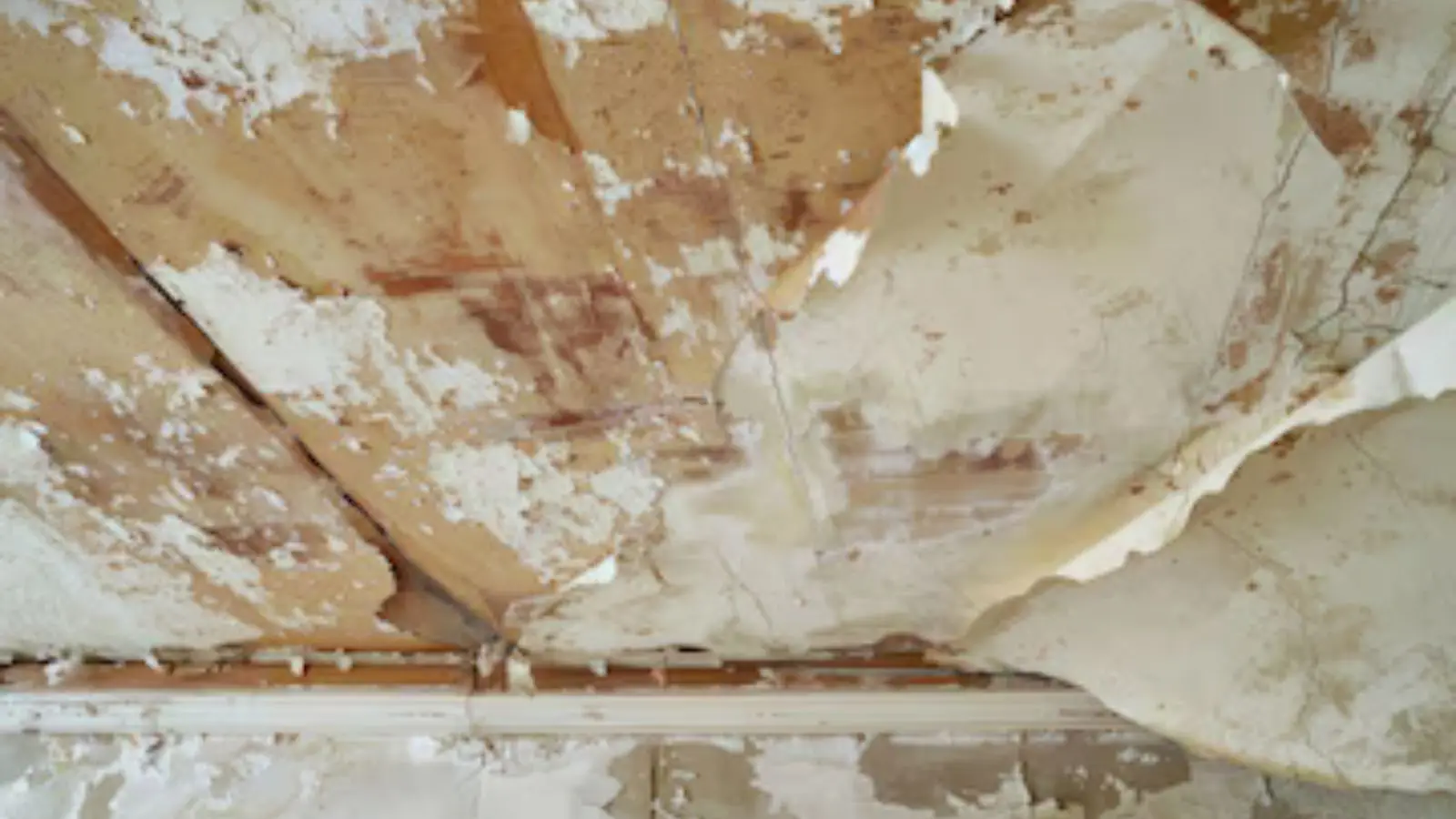
Ceiling repair water damage jobs in Tewksbury, MA all follow one order: stop the source, dry everything above and behind the ceiling, remove what stayed wet, then rebuild. Paint comes last, never first.
This guide covers the repair side, after the water has stopped and the area has been dried. A small brown ring may need a patch and primer. A sagging section needs to come down and be replaced. We explain how to tell which is which, and where a homeowner's job ends and a pro's begins.
Find the source before you cut anything
Callers describe the same few culprits: a closet ceiling under a bathroom, a bedroom ceiling under an AC condensate line, a hallway stain under a roof valley. Check the room above first. Look at the toilet supply, the tub overflow, the shower pan and the condensate drain on the air handler.
If nothing upstairs is wet, go into the attic with a flashlight. Dark rings on roof sheathing, wet insulation and daylight around a vent pipe point to the roof. A moisture meter confirms the leak has actually stopped.
The Massachusetts Department of Public Health mold guide says to find the water source and fix it, or mold will not stop growing. Plumbing, electrical and roof fixes belong with an experienced or licensed professional.
Which repair does your ceiling need?
The condition of the surface decides the job. Press gently with a gloved hand and look for softness, not just color.
| Ceiling condition | What it means | Typical repair |
|---|---|---|
| Small stain, surface firm | Brief leak, drywall stayed mostly intact | Confirm dry with a meter, seal with stain-blocking primer, repaint the whole ceiling plane |
| Soft spot or bubbling paint | Paper face and gypsum core absorbed water | Cut out the wet section back to firm drywall, patch, tape, mud, prime, paint |
| Sagging or bowed | Drywall is holding water and has lost strength | Call a pro. Keep out from under it. Controlled removal, then replace the section |
| Collapsed | Water weight or failed fasteners brought it down | Treat as an emergency. Clear the room, cut power to the area, call for removal and drying |
Cutting out wet drywall or plaster
Turn off power to the room at the breaker before you cut near a light fixture or fan. Mark a rectangle that reaches past the stain onto dry, solid material, score it with a utility knife and finish with a drywall saw. Cut shallow so you do not slice wiring or a pipe. Wear gloves, eye protection and a dust mask.
Wet plaster on lath lets go of its keys, the blobs that hold it to the lath, and can drop in one heavy piece. Do not poke at a bulging plaster ceiling. That job calls for a crew with dust control.
Check the insulation and framing above
Once the hole is open, look above it. Wet batt insulation loses its loft and holds moisture against the drywall, so it comes out. Blown cellulose stays damp longer than fiberglass, so trust a meter reading over appearances.
Probe the joists and roof sheathing with a pin-type moisture meter. If readings stay high, a thermal imaging camera can show whether wet spots reach beyond the hole you cut.
Patch a section or replace the ceiling?
A single stained bay between two joists is a patch. Fix a backer to the joists, fit a piece of matching thickness, tape the seams and build up thin coats of joint compound. Sand between coats and feather the edges wide.
Replace the whole ceiling panel when damage runs across several joist bays or the texture would never match a patch. Popcorn, knockdown and orange peel are hard to blend, and re-texturing the full plane looks better than a visible square.
For wider damage, our water damage repair page explains how rebuild work is scoped after drying is signed off.
Stain-blocking primer and paint
Brown tannin and rust stains show through ordinary latex paint. Use a shellac-based or oil-based stain-blocking primer on the stained area, then a full coat of ceiling paint across the entire plane, edge to edge. Spot-painting leaves a flashing patch that catches raking light.
Before sanding old paint, remember that disturbing more than 6 square feet of painted interior surface triggers the Massachusetts lead-safe renovation rules. A ceiling patch can reach that number quickly once you count the sanding zone.
Never cut, sand or patch a ceiling near a light fixture, fan or junction box until the breaker is off and a meter confirms the framing is dry. Water and wiring in the same cavity is a job for a licensed electrician before any repair starts.
What drives the cost of a ceiling repair
No honest number exists without seeing the ceiling. The price moves with the size of the wet area, whether the water was clean or contaminated, how many layers were involved, ceiling height, texture matching, and whether drying days and equipment came first.
Want your real number? Call (978) 252-8637 and describe the stain, the room above and how long it has been wet.
When to stop and call
Call a professional if the ceiling sags, if the stain keeps growing after the source is fixed, if insulation is soaked, or if you see fuzzy growth. The state mold guide sends mold-affected areas of more than 10 square feet to professionals.
Neighbors in Wilmington and Billerica can reach the same crews through their own town pages.
If the ceiling is wet from a long-running leak, our water mitigation crews can dry the cavity before any rebuild begins.
What Tewksbury homeowners should know about permits and rebuild work
The Tewksbury Building Department, at 1009 Main Street, Lower Level, enforces the Massachusetts State Building Code and the town zoning by-laws. Building, electrical, plumbing and gas permits are applied for through the Town's online permit portal. Its permit FAQ does not list which repairs need a permit, so ask the Building Department before you start.
That question matters most when the repair goes past paint and a patch. Replacing a ceiling with new wiring, moving a light box or fixing the pipe that caused the leak can all fall under electrical or plumbing permits. A quick call before the work saves you from tearing out finished drywall later.
Common questions about this topic
Only after the leak is fixed and the area reads dry on a moisture meter. Even then, plain paint will let brown stains ghost through. Seal the spot with a stain-blocking primer first, then paint the full ceiling so the sheen matches.
Press on it. If it feels soft, crumbles, sags or the paper face has split, that section has lost strength and should be cut out. Firm drywall with only a surface stain can usually be primed and painted.
Usually yes if it stayed wet. Compressed or damp insulation holds moisture against the framing and drywall. Dry fiberglass that never got soaked can sometimes be saved, but a meter reading should decide.
The source is probably still active, or the framing above was still damp. Check the room above, the roof and the AC condensate line, then dry the cavity before repainting.
No. A bulging ceiling can hold trapped water and drop without warning. Stay out from under it, keep the room closed and call a professional for controlled removal.
The Town's permit FAQ does not list which repairs need one, so ask the Tewksbury Building Department at 1009 Main Street before work begins.