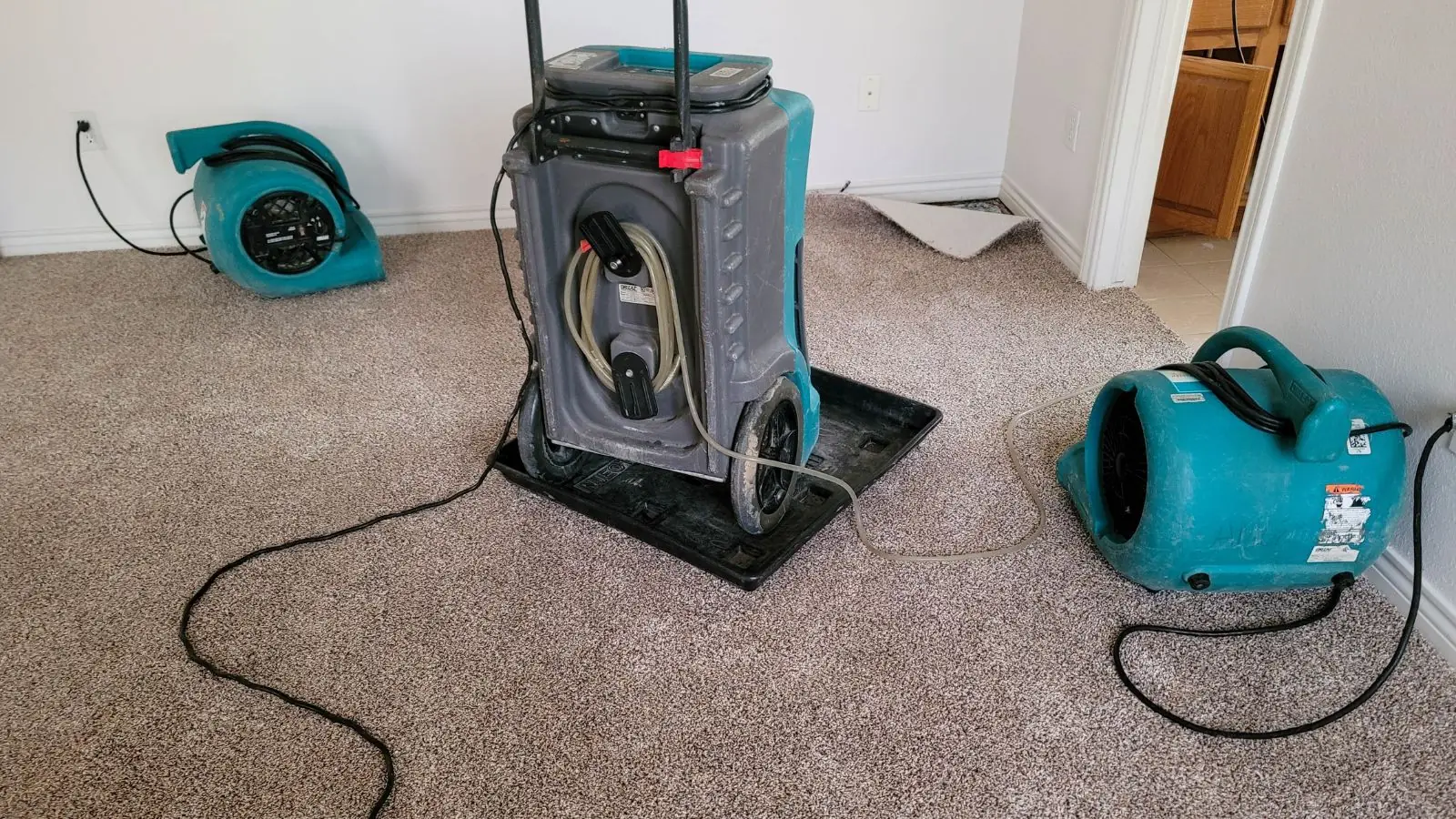
Structural drying services in Tewksbury, MA mean removing moisture from the parts of a building you cannot see: studs, subfloor, wall cavities, insulation and the space behind cabinets. Towels and a box fan dry the surface. Structural drying uses measured airflow, dehumidification and daily readings to reach a target.
That target is a dry standard, based on unaffected material in the same home. Crews do not stop when the surface feels dry. They stop when the meter matches the reference, which is why a job can run for several days.
Why drying takes days, not hours
Water soaks into wood, drywall and plaster much faster than it leaves. Moisture has to move from deep inside the material to the surface and into the air, and the air has to be dry enough to take it. Push too hard and wood cracks or cups. Push too softly and mold gets a head start.
The Massachusetts DPH mold guide says wet areas should be completely dried in 24 hours, and under the state housing code areas exposed to leaks or floods must be dried within 48 hours. The EPA says the same window, 24 to 48 hours, usually prevents mold growth. Equipment is how crews hit that window.
The equipment and where it goes
| Equipment | What it does | Where it goes |
|---|---|---|
| Air movers | Push air across wet surfaces to speed evaporation | Along walls and across floors, angled to sweep the surface |
| LGR dehumidifiers | Pull water vapor out of the air so materials can keep releasing moisture | In the affected area or a central spot, with doors closed |
| Moisture meters (pin and pinless) | Read moisture in wood, drywall and concrete | On walls, floors and framing, at marked spots, every visit |
| Thermal imaging camera | Shows temperature differences that suggest hidden wet areas | Walls, ceilings and floors during mapping and checks |
| Hygrometer | Measures temperature and humidity in the air | In the room and at the dehumidifier outlet |
| Cavity drying systems | Push warm, dry air through small openings into wall or floor cavities | Hollow walls, toe kicks and under cabinets where open air cannot reach |
| HEPA air scrubbers | Filter dust and particles during removal | In work zones where wet materials are cut out |
How crews set up a dry-out
Find the water
Meters and a thermal imaging camera map where the water went, not just where it shows.
Extract
Extraction units pull standing water. Soaked carpet pad and loose insulation come out.
Open up
Baseboards come off, and small holes may be made so air can get into cavities.
Place equipment
Air movers and LGR dehumidifiers go in by room volume and wetness, not by guess.
Record a baseline
Readings and humidity are logged so progress can be seen.
Drying goals and daily monitoring
The goal is to return materials to their normal moisture content. Crews pick a dry standard from unaffected wood or drywall in the same house, then compare each day. S500 is the published standard for water damage restoration, and homeowners can ask any company whether its crews work to it.
Each visit, the crew rereads the marked spots, checks humidity, adjusts air movers and removes equipment from areas that have reached goal. A job with no daily readings is a job you cannot verify.
Our water mitigation service page describes the first steps for a new dry-out.
What you should and should not do with the equipment
- Do keep the equipment running, including overnight. Noise is part of the process.
- Do keep doors and windows closed in the drying zone so the dehumidifiers work on the right air.
- Do not unplug a machine to charge a phone or use the outlet. Ask the crew about a different outlet.
- Do not move air movers or point them at furniture. Placement is by design.
- Do not turn off a dehumidifier because the room feels dry. The meters decide.
- Do not open a wall or lift a floor yourself to check. Let the crew do it.
Equipment needs power, and cords across wet floors are a hazard. If water is near an outlet or panel, turn off the breaker first and have an electrician check before the crew plugs anything in.
How to tell drying is finished
Finished means the meter readings at the marked spots match the dry standard, humidity in the room has returned to normal, and no thermal imaging hot or cold spots remain. The crew should show you the logged readings. Surface feel, a lack of smell or a warm room are not proof.
After sign-off, rebuild decisions can start. Our water damage repair page covers what comes next, such as replacing drywall, flooring and cabinets that could not be saved.
What affects the number of drying days
Drying time depends on the water category, the area affected, the materials, how long the water sat, outdoor humidity, and whether cavities and layers like pad, subfloor or plaster hold water. Dense materials such as hardwood and plaster take longer than drywall. Call (978) 252-8637 for a scope based on your own conditions.
Wilmington sits southeast of Tewksbury, and its service area page lists that coverage. Billerica, to the southwest, has its own water damage page.
The Massachusetts drying rule in plain terms
Under the Massachusetts housing code, areas exposed to leaks or floods must be dried within 48 hours. The state DPH mold guide goes further and says wet areas should be completely dried in 24 hours. The practical reading: begin drying at once and aim to have the reachable structure dry inside those two days.
So start drying the same day, keep dated photos and the crew's readings, and ask your insurer what your policy requires. Mold-affected areas of more than 10 square feet are a job for professionals.
Common questions about this topic
It is the process of removing moisture from building materials such as studs, subfloor and drywall using air movers, LGR dehumidifiers and daily moisture readings until they reach a dry standard.
Usually several days. The number depends on the materials, the amount of water and how long it sat. A crew decides by readings, not by the calendar.
For a small, fresh spill, maybe. For water inside walls or under flooring, consumer equipment rarely moves enough air or removes enough vapor, and without a meter you cannot know when to stop.
Air movers and dehumidifiers work around the clock. Turning them off lets moisture settle back into the materials and extends the job.
Ask to see the readings. Moisture content at marked spots should match your dry standard, and humidity should be back to normal. The S500 standard guides this process.
The state housing code says areas exposed to leaks or floods must be dried within 48 hours, and the DPH mold guide says wet areas should be completely dried in 24 hours. Start immediately and document your readings.