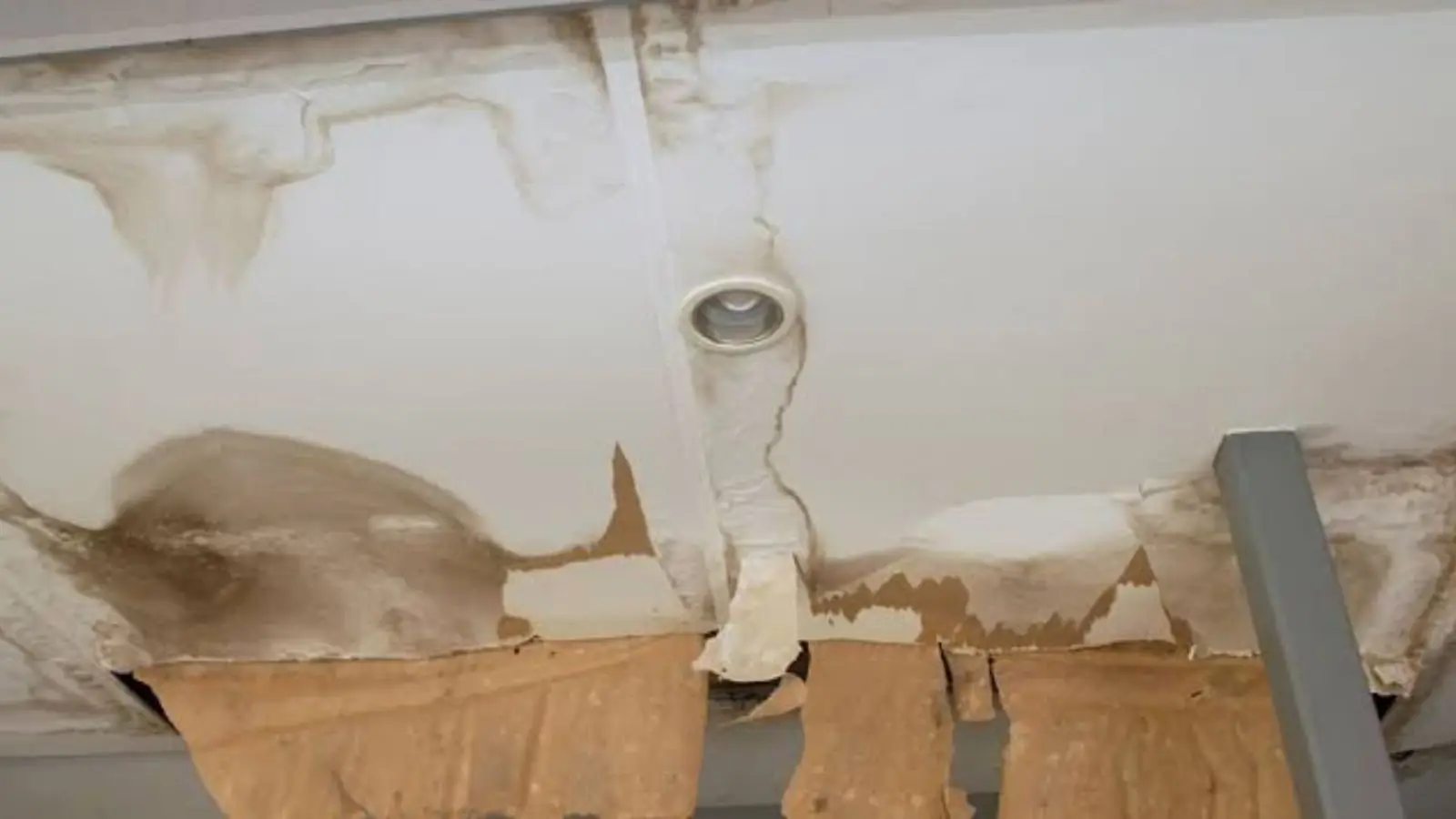
A water damaged ceiling in Tewksbury, MA is a safety question first and a repair question second. Water has weight, a bulging ceiling can drop without warning, and wiring may run through the same wet cavity. Before you think about paint, decide whether it is safe to be in the room.
Stay out from under any ceiling that sags, bows or drips steadily. Turn off power to that room at the breaker if a light fixture or fan is wet. Then work out where the water is coming from. A stain tells you more than most people expect.
Reading the stain
| What you see | What it usually means | How urgent |
|---|---|---|
| Brown ring with a darker outer edge | Repeated wetting and drying, an older or recurring leak | Find the source soon |
| Yellow or tan patch, soft edges | A slower, lighter leak or condensation | Inspect this week |
| Fresh dark patch, still damp | Active leak right now | Act today |
| Bubbling or peeling paint | Moisture trapped behind the paint film | Check the framing above |
| Bulge or sag | Water is held in the drywall or plaster | Emergency. Keep out from under it |
| Stain plus drips from a fixture | Water inside the electrical box | Emergency. Breaker off now |
Rings form because water spreads outward, dries at the edge and leaves minerals and dirt behind. Each new wetting adds another ring, so a ceiling with several rings has had several leaks, not one.
Sagging and bulging ceilings: stay out
A bulge means water has pooled above the drywall or plaster. A single wet bay can hold a surprising weight, and the fasteners and paper face fail without a sound. Plaster ceilings can come down in one heavy sheet.
Move people and pets out of the room, move furniture clear if you can do it without standing under the bulge, and close the door. Do not poke it, prop it up with a broom or try to staple it back.
Do not stand under a bulging ceiling to relieve it, and do not puncture it if there is any chance of wiring, a light fixture or an attic hatch nearby. Water can follow the wire into the fixture. When in doubt, leave it and call.
Relieving trapped water, only if it is safe
Some people drill a small hole in a bulge to let the water out in a controlled stream. That reduces the weight, but only in a specific situation. The area must be clear of light fixtures, fans, junction boxes and wiring. The power to the room must be off at the breaker. You need to stand to the side with a bucket below, and the ceiling must be drywall, not plaster.
If any of those conditions is missing, do not do it. A ceiling that has already cracked or stretched, or one with a fixture in the bulge, is a crew job. Professionals can open it in a controlled way, catch the water, and protect the floor below.
Electrical fixtures in a wet ceiling
Water and wiring are a bad pair. If a light is dripping, flickering or has water in the glass globe, turn it off at the switch and the breaker. Do not use the fixture again until an electrician checks it. A wet recessed can light or ceiling fan housing is not a DIY problem.
If the breaker panel is in a wet basement or you must stand in water to reach it, do not go near it. Call for help. The Massachusetts DPH guide notes that plumbing, electrical, structural and roof repairs belong with an experienced or licensed professional.
Where the water is coming from
Think about what sits above the stain. Upstairs bathroom leaks show up as a ring or sag below a toilet, tub or shower, and often appear after the fixture has been used. Roof leaks follow rain or melting snow and show up near chimneys, vents, valleys and eaves. AC condensate leaks appear in summer under an air handler, often when the drain line clogs.
A moisture meter and a thermal imaging camera help crews trace the line of travel, because water often runs along a joist before it drops.
Our water mitigation page explains how crews dry the framing once the source is found.
When it is an emergency
- The ceiling is sagging, bowed or cracking along the seams.
- Water is dripping steadily or running out of a light fixture.
- The leak followed a burst pipe or heavy storm and is still active.
- You smell something burning, or the fixture sparks or trips the breaker.
- A large area, more than 10 square feet, is wet or discolored.
In those cases, shut off the water at the main if the source is plumbing, shut off power to the room, and call (978) 252-8637. Many callers just want someone to look at it, and any item above is reason enough to ask.
After the water is dealt with
Drying, not paint, decides whether the ceiling is saved. The EPA says drying wet materials within 24 to 48 hours usually prevents mold growth. Once the area reads dry, repair can start, and our water damage repair service covers that side.
For homes closer to the Lowell side of the Merrimack, the Lowell water damage page lists that service area. Chelmsford residents across the Concord River can see the Chelmsford service area.
Rivers around Tewksbury and ceiling leaks
The Merrimack River forms part of Tewksbury's northern boundary. The Shawsheen River runs through the southern end of town, and the Concord River borders it on the southwest. River flooding comes from the ground up, so it usually soaks basements and first floors, not ceilings.
A ceiling stain points to water from above: a roof, a bathroom or an air handler. If you live near the water and see both a wet basement and a wet ceiling, you may have two problems with two sources. Check the FEMA Flood Map Service Center for your address, and treat river water as Category 3.
Common questions about this topic
A brown or yellow stain means water has soaked through and carried dirt and minerals into the drywall. Rings usually mean repeated wetting. The stain does not tell you if the leak is still active, so check with a moisture meter.
Yes. A sag means water is held in the ceiling material. Stay out from under it, shut off power to the room if fixtures are involved, and call a professional.
Only if you can confirm no wiring or fixtures are in the bulge, power to the room is off, and you can stand clear with a bucket. If you cannot confirm all of that, do not do it.
Turn off the switch and the breaker for that room first. Do not touch the fixture. Keep the room clear and call a professional and an electrician if the fixture got wet.
Look at what is above. If the stain is under a bathroom, check the toilet, tub and shower. If it follows rain, check the roof, vents and flashing from the attic.
Not directly. Merrimack, Shawsheen and Concord river flooding affects low areas first. Ceiling water comes from above, such as a roof, bathroom or air handler. Check the FEMA flood map for your address if you want to know about flood risk.